Little vs. Big: Why Smaller Memory Care Homes Typically Supply Better Dementia Care
Families usually start looking into memory care after something concrete takes place. A parent roams out in the evening. Medications get blended. A fall ends up being the 3rd journey to the ER in 6 months. What looked like regular aging suddenly feels like dementia care, and the stakes get really real.
That is normally when the huge concern arrive at the table: a big assisted living neighborhood with a memory care wing, or a smaller sized, home-style setting that concentrates on dementia?
I have walked families through both options for years. I have sat at kitchen area tables after a wandering event, and in conference spaces with marketing directors from big senior care chains. Huge neighborhoods and little homes both have their location, and neither is instantly "good" or "bad". Still, in numerous situations, smaller sized memory care homes quietly provide much better results, particularly for people with moderate dementia.
The reasons are not abstract. They show up in who notices a urinary system infection early, who catches that Dad has actually stopped consuming, and who has the time to stand calmly with a scared resident at 2 a.m. The size of the setting shapes those moments.
What families observe initially when they stroll in
When I tour with families, I see their faces throughout the first sixty seconds. You can discover a lot before anyone says a word.
In a big assisted living neighborhood with a protected memory care unit, you typically go through a lobby that looks like a hotel. High ceilings, huge chandeliers, large hallways. By the time you reach memory care, you have actually walked a good distance. The front door opens to a long corridor, a main sitting location, and a number of side halls. Activity depends upon the time of day. Some homeowners circle the system, some being in recliner chairs, a few ask how to get home.
In a smaller sized memory care home, particularly the residential-style ones, you typically step directly into the primary living location. You can often see almost the whole area: kitchen, dining table, sitting area, sometimes a little backyard through a glass door. Personnel remain in the middle of it, not tucked away at a desk. Sound tends to be lower. The entire setting feels more like a shared house than a facility.
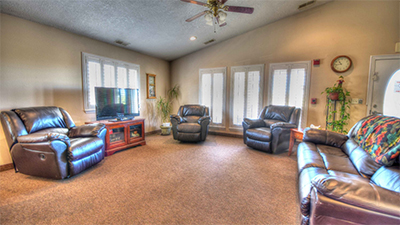
Families frequently say the very same 2 aspects of little homes on that first visit. Initially, "I seem like Mom would actually be seen here." Second, "I might envision us having Sunday lunch at this table."
Those instincts are not sentimental. They point towards structural distinctions that matter, both scientifically and emotionally.

How size shapes life in memory care
Dementia narrows a person's world. New details is harder to process and maintain. Large, complicated environments puzzle and tiredness people who when browsed airports and workplace parks without a doubt. An individual with dementia will usually do finest in an easier, more foreseeable setting.
In a large memory care unit, there may be 25 to 60 residents, with numerous corridors, activity elder care spaces, and shared spaces. Personnel projects change by shift. The activities calendar is typically complete on paper: bingo, crafts, home entertainment, workout. In practice, participation varies extensively. Residents who can still initiate and follow group hints might benefit from bigger, structured activities. Those additional along in their disease may rest on the edges or stay in their rooms.
In a small memory care home, you might have 6 to 16 homeowners, all sharing the exact same open living and dining spaces. Staff usually support everybody, not simply "their side of the hall". Activities tend to be woven into typical household routines rather of standing alone as events. Folding laundry, stirring a pot of soup, deadheading flowers on the patio area, cleaning the table, or sorting buttons can all end up being significant engagement.
One afternoon in a ten-resident home, I enjoyed a caregiver spontaneously turn mail delivery into an activity. She handed envelopes to a resident who had actually been a secretary and asked her to "assist arrange the mail like you used to at the office". For twenty minutes, that resident was focused, purposeful, and smiling. In a larger setting with 40 citizens, that kind of customization is more difficult to manage regularly. Staff should move rapidly and cover more ground.
Daily life likewise looks various in little homes when it comes to pacing. Big neighborhoods tend to work on tight schedules driven by staffing patterns, dining service, and transportation. Breakfast might be "served from 7 to 9", but in truth, hot food is easiest early in the window. Bathing gets slotted into particular hours. The pressure of "getting everybody done" is real.
Small homes have their own limitations, however they often flex around the rhythms of the residents more quickly. If someone wakes later on and chooses to eat at 10 a.m., it is usually simpler to prepare eggs for one person in a little, open kitchen area than to reopen a commercial-style dining-room. That flexibility can mean fewer battles over showers and meals, and less agitation throughout transitions.
Relationships, staffing, and connection of care
Ask any skilled dementia care professional what makes or breaks quality, and sooner or later they come back to staffing. Ratios matter, but continuity and relationship depth matter even more.
In a large memory care unit, the main staffing ratio may look similar to a small home on paper. For instance, 1 caregiver for every 6 to 8 citizens throughout the day. The distinction is the number of total people cycle through the system. Large communities often have a much deeper bench of part-time and float personnel, which assists them cover call-outs however also increases turnover at the bedside.
Residents with dementia struggle to recognize and trust new faces. If the caretaker aiding with an intimate job like toileting or bathing changes every couple of days, resistance normally climbs. That leads to more time invested managing "behaviors" and less time on reassuring, familiar routines.
In smaller memory care homes, staffing lineups are often much shorter and more steady. The same 3 or four caretakers may cover most daytime shifts for months or years. Owners or supervisors are typically present on website, not in a remote corporate workplace. I have actually seen homeowners greet a small home supervisor like an extended relative, and I have seen that manager quietly action in to assist feed lunch when a shift runs tight.
Smaller scale also changes how rapidly personnel notification difficulty. In a ten-resident home, it is apparent if somebody has not come to the table or has left half their meals untouched for two days. Subtle shifts in gait, state of mind, or alertness stand out. In bigger systems, those changes are much easier to miss out on in the middle of the circulation of 30 or 40 people.
I once sought advice from on a case where an early urinary system infection was picked up in a small home since a caregiver discovered that a resident was slightly more withdrawn and had actually gone to the restroom 3 extra times that early morning. The caretaker knew this lady's routine that well. In a big unit, where staff are accountable for a lot more residents topped a wide location, those delicate patterns can disappear in the crowd.
All that stated, little homes are not automatically much better staffed. Some cut corners and run too lean, particularly in the evening. Households should always ask to see actual staffing schedules, compare day, evening, and over night protection, and listen thoroughly to how caretakers speak about their workload.
Environment, sensory load, and "feeling lost"
People with dementia work hard throughout the day to understand their environments. A high-stimulation environment can tip them into confusion or agitation, even when nothing "bad" is happening.
Large assisted living and memory care buildings tend to be noisy and visually hectic. Overhead statements, TVs, people talking in hallways, shipments, vacuum, cooking area clatter, beeping devices, and the echo of big spaces all mix together. Add complex layout with identical doors and long hallways, and many homeowners feel lost even with personnel close by.
That sense of being lost matters. When someone can not anchor themselves to a psychological map, they ask more recurring questions, roam more, and frequently feel more nervous. Personnel then invest much of their time redirecting or reassuring in a setting that constantly damages that reassurance.
Smaller memory care homes generally have simpler layouts and a lower sensory load. A resident can typically see the cooking area, the front door, and the yard from a single chair. Ambient noise tends to be limited to conversation, a television in one corner, and normal family sounds. Some homes keep the tv off except for specific programs, which dramatically quiets the space.
I keep in mind one male with moderate dementia who had been pacing endlessly and calling out for his wife in a large memory care unit. Staff did their finest, but he was overstimulated and terrified. When he transferred to a twelve-bed residential home, he still paced, but the route was short, familiar, and anchored by the table and back entrance. Within two weeks, his consistent calling out had dropped sharply. Nothing magic had actually changed in his brain, however the environment no longer provoked the very same level of distress.
For individuals with sophisticated dementia, the scale of area matters a lot more. Having the ability to move easily within a small, safe, and contained environment may be better than living in a large unit where doors and alarmed exits must constantly be controlled. Little homes can sometimes produce safe and secure outside access more easily, considering that they might have a single fenced yard rather than numerous patio areas off long corridors.
Managing behavioral signs and safety
Safety is usually leading of mind for families considering memory care. Roaming, falls, aggressiveness, and resistance to care are real issues. Size influences how these problems are handled.
In bigger communities, security systems are typically more advanced. Door alarms, wander-guard bracelets, coded elevators, and several personnel on each shift supply layers of security. Policies are well recorded, training programs are standardized, and there may be dedicated nurses on website around the clock, particularly in bigger senior care campuses that integrate assisted living and skilled nursing.
The trade-off is that actions can end up being more procedural and less individualized. A resident who declines a shower may be placed on a "behavior plan" that includes structured attempts at certain times, with documentation requirements that strain already minimal personnel time. Medication changes may be rolled out by means of consulting psychiatrists or telehealth, with differing degrees of follow-through.
In small homes, security relies more greatly on direct observation and familiarity. Caretakers generally understand who tends to test doors, who gets up at night, and who requires closer watch after a family visit or medical procedure. Interventions can be subtle and relational: moving a seat at the table, adjusting lighting in the evening, or giving someone a "job" at a specific time of day when they usually end up being restless.
That flexibility sometimes equates into fewer psychotropic medications. A resident who may have been identified "exit seeking" in a large unit may be workable in a small home through structured walking, individually reassurance, and an easier environment. I have seen antipsychotic and sedative dosages decreased or removed after such moves, though this always needs mindful medical supervision.
There are limitations. If an individual's behaviors become physically harmful, or if they need intricate medical interventions, a larger setting with more specific resources may be safer. Households need to prevent presuming that "homey" constantly equates to "able to handle anything."
When bigger memory care or assisted living may be a better fit
It is easy to romanticize small memory care homes. Many are worthy of that love, however they are not the best option for every single situation.
Large assisted living neighborhoods and memory care units can be a better fit in several situations. A person in the really early stages of dementia who still flourishes on varied activities, larger social circles, and features like physical fitness spaces and set up trips might really feel more engaged in a larger setting. They might enjoy restaurant-style dining, clubs, and a calendar loaded with options.
Larger neighborhoods likewise tend to have more on-site medical support. Some have 24/7 nursing coverage, visiting doctors numerous days a week, on-site physical and occupational therapy, and developed relationships with health centers and hospice companies. For homeowners with multiple complicated medical conditions on top of dementia, that infrastructure can matter.
Families in some cases discover that big neighborhoods are better geared up for respite care also. Short-term stays, maybe after a hospitalization or while a primary caretaker takes a break, are frequently much easier to arrange in bigger settings that have a consistent flow of admissions and discharges. A little home may just have an opening one or two times a year, and may focus on long-term placements over respite.
Finally, expense structures differ. While small homes are in some cases less expensive than high-end assisted living, they can likewise be costlier on a per-resident basis because economies of scale are limited. An extremely tight budget plan might push households towards larger neighborhoods that can spread out fixed costs across numerous residents.
The decision is hardly ever easy. It helps to be specific about your loved one's specific needs, instead of assuming that one model transcends in all respects.
Cost, policy, and what "little" actually means
The words "small memory care home" cover several various designs, each with its own regulatory and monetary realities.
In many states, residential care homes operate under the very same license classification as assisted living, just on a smaller scale. A single-story home may be refurbished to serve 6 to 12 citizens, with security upgrades and expert staff. Other states have particular classifications for "adult household homes" or "board and care homes." Some small homes operate as dedicated memory care, while others serve a mix of locals with and without dementia.
Regulations in the United States normally set minimum staffing, safety, and training requirements, but enforcement quality differs. I have seen small homes that go beyond every standard and feel like prolonged families. I have also seen little homes that feel under-resourced, isolated, and badly supervised. A warm environment can conceal major problems if families do not look under the hood.
Large memory care systems within assisted living neighborhoods or senior care campuses are normally subject to the exact same licensing, however they take advantage of business compliance departments, standardized policies, and internal audits. They can buy staff training programs that smaller operators can not quickly duplicate. On the other hand, business concerns might stress occupancy and margins, which can form everyday truths in methods households never see.
Financially, small memory care homes often charge complete regular monthly rates for space, board, and care, with occasional add-ons for really high needs. Big neighborhoods more frequently utilize tiered prices, where base lease covers housing and meals, and care is billed at various levels depending upon how much support a resident requires. Comparing costs can be difficult, because you are typically taking a look at different pricing designs and service bundles.
What "small" means in practice likewise matters. A 16-resident home with a thoughtful design and trained staff can feel easier to browse than a sprawling 30-bed unit, but a poorly run 8-bed home can feel chaotic if staffing is thin. Size produces possibilities; it does not ensure outcomes.
How smaller sized homes support households as well as residents
Families in some cases ignore just how much their own lifestyle will depend upon the environment they choose for memory care or assisted living. A small home's effect on household stress can be substantial.
Communication is frequently more direct in little settings. The individual answering the phone might be the exact same caregiver you met at admission, and they likely know exactly what happened with your loved one that morning. There is less threat of messages getting lost between shifts, and family concerns typically reach the decision-maker quickly.
Families also tend to feel more welcome in small homes. Bringing in a homemade cake, joining a meal, or sitting quietly in the living-room for an hour feels natural. Kids and family pets frequently incorporate more quickly. That sense of being part of a prolonged home can ease the regret numerous adult kids bring when moving a parent into senior care.
In bigger neighborhoods, families can certainly develop strong relationships with personnel, but they typically should navigate more layers: front desk, nurses, care managers, activity personnel, administration. The benefit is access to more formal family conferences, support system, and resources. The disadvantage is that it might feel more like interacting with an organization than with a household.

I worked with one child who moved her mother with sophisticated dementia from a 60-bed memory care system to an eight-bed home more detailed to her own home. She told me 3 months later on, "I still visit 4 times a week, but I no longer spend the drive stressing over what I am going to discover. I understand individuals there. They notice the little things. I can simply be her child once again rather of her case manager."
That shift from consistent oversight to shared trust is one of the peaceful gifts of a well-run small home.
Signs a smaller sized memory care home might be the better fit
Below are patterns I expect when suggesting families prioritize smaller memory care settings:
- Your loved one ends up being quickly overwhelmed by noise, crowds, or complicated spaces.
- They are in the middle or later phases of dementia and no longer take advantage of large-group activities.
- They react highly to familiar routines and individually reassurance.
- You worth becoming part of a close-knit care group and desire frequent, casual updates.
- You are comfortable with a "household" feel rather than hotel-style amenities.
If several of these ring true, a great small home can often offer calmer, more customized dementia care than a large center, presuming both are well run.
Questions to ask when visiting small and big memory care options
Whatever setting you favor, the quality of dementia care boils down to specifics. Utilize these concerns to probe beyond the sales brochures when you visit:
- How many caregivers are on task throughout days, evenings, and nights, and how frequently do tasks change?
- Who decides when to call the physician, change medications, or involve hospice, and how are households included?
- How do you deal with a resident who refuses bathing, medications, or meals, specifically if this occurs repeatedly?
- What does a typical day look like for someone at my loved one's level of dementia, from awakening to bedtime?
- Can you tell me about a time when something went wrong here, and what you changed afterward?
Listen not simply to the material of the answers, but to their tone. People who genuinely comprehend dementia care will speak concretely about compromises, limits, and genuine examples. They will not pretend that your loved one will "never ever fall" or "always be happy" in their care.
Choosing in between a small memory care home and a bigger assisted living community is less about square video and more about fit. Dementia compresses an individual's world. The best setting restores as much security, comfort, and significance as possible within that smaller sized space, for both the resident and the family.
For many people with dementia, smaller memory care homes tilt the balance in their favor. They simplify the environment, deepen relationships in between staff and residents, and allow senior care to feel individual at a phase of life when a lot else is slipping out of reach. The secret is not size alone, however how well the people inside that space comprehend the truths of dementia and devote to strolling that road with you.
Business Name: BeeHive Homes of Four Hills
Address: 13450 Wenonah Ave SE, Albuquerque, NM 87123
Phone: (505) 221-6400
BeeHive Homes of Four Hills
Beehive Homes assisted living care is ideal for those who value their independence but require help with some of the activities of daily living. Residents enjoy 24-hour support, private bedrooms with baths, medication monitoring, home-cooked meals, housekeeping and laundry services, social activities and outings, and daily physical and mental exercise opportunities. Beehive Homes memory care services accommodates the growing number of seniors affected by memory loss and dementia. Beehive Homes offers respite (short-term) care for your loved one should the need arise. Whether help is needed after a surgery or illness, for vacation coverage, or just a break from the routine, respite care provides you peace of mind for any length of stay.
13450 Wenonah Ave SE, Albuquerque, NM 87123
Business Hours
BeeHive Homes of Four Hills provides assisted living care
BeeHive Homes of Four Hills provides memory care services
BeeHive Homes of Four Hills provides respite care services
BeeHive Homes of Four Hills supports assistance with bathing and grooming
BeeHive Homes of Four Hills offers private bedrooms with private bathrooms
BeeHive Homes of Four Hills provides medication monitoring and documentation
BeeHive Homes of Four Hills serves dietitian-approved meals
BeeHive Homes of Four Hills provides housekeeping services
BeeHive Homes of Four Hills provides laundry services
BeeHive Homes of Four Hills offers community dining and social engagement activities
BeeHive Homes of Four Hills features life enrichment activities
BeeHive Homes of Four Hills supports personal care assistance during meals and daily routines
BeeHive Homes of Four Hills promotes frequent physical and mental exercise opportunities
BeeHive Homes of Four Hills provides a home-like residential environment
BeeHive Homes of Four Hills creates customized care plans as residents’ needs change
BeeHive Homes of Four Hills assesses individual resident care needs
BeeHive Homes of Four Hills accepts private pay and long-term care insurance
BeeHive Homes of Four Hills assists qualified veterans with Aid and Attendance benefits
BeeHive Homes of Four Hills encourages meaningful resident-to-staff relationships
BeeHive Homes of Four Hills delivers compassionate, attentive senior care focused on dignity and comfort
BeeHive Homes of Four Hills has a phone number of (505) 221-6400
BeeHive Homes of Four Hills has an address of 13450 Wenonah Ave SE, Albuquerque, NM 87123
BeeHive Homes of Four Hills has a website https://beehivehomes.com/locations/four-hills/
BeeHive Homes of Four Hills has Google Maps listing https://maps.app.goo.gl/32p1Aa3RPZqoYGBS7
BeeHive Homes of Four Hills has TikTok page https://www.tiktok.com/@beehive4hills
BeeHive Homes of Four Hills has an YouTube page https://www.youtube.com/@WelcomeHomeBeeHiveHomes
BeeHive Homes of Four Hills has Facebook page https://www.facebook.com/beehivehomesoffourhills
BeeHive Homes of Four Hills has Instagram page https://www.instagram.com/beehivehomesfourhills/
BeeHive Homes of Four Hills won Top Assisted Living Homes 2025
BeeHive Homes of Four Hills earned Best Customer Service Award 2024
BeeHive Homes of Four Hills placed 1st for New Mexico Senior Living Communities 2025
People Also Ask about BeeHive Homes of Four Hills
What is BeeHive Homes of Four Hills Living monthly room rate?
The rate depends on the level of care that is needed. We do a pre-admission evaluation for each resident to determine the level of care needed. The monthly rate is based on this evaluation. There are no hidden costs or fees
Can residents stay in BeeHive Homes of Four Hills until the end of their life?
Usually yes. There are exceptions, such as when there are safety issues with the resident, or they need 24 hour skilled nursing services
Do we have a nurse on staff?
No, but each BeeHive Home has a consulting Nurse available 24 – 7. if nursing services are needed, a doctor can order home health to come into the home
What are BeeHive Homes of Four Hills's visiting hours?
Visiting hours are adjusted to accommodate the families and the resident’s needs… just not too early or too late
Do we have couple’s rooms available?
Yes, each home has rooms designed to accommodate couples. Please ask about the availability of these rooms
Where is BeeHive Homes of Four Hills located?
BeeHive Homes of Four Hills is conveniently located at 13450 Wenonah Ave SE, Albuquerque, NM 87123. You can easily find directions on Google Maps or call at (505) 221-6400 Monday through Sunday 9:00am to 5:00pm
How can I contact BeeHive Homes of Four Hills?
You can contact BeeHive Homes of Four Hills by phone at: (505) 221-6400, visit their website at https://beehivehomes.com/locations/four-hills/ or connect on social media via TikTok Facebook or YouTube
Conveniently located near Beehive Homes of Four Hills Icon Cinemas a great movie theater with full food & drink menu. Catch a movie and enjoy some great food while you wait.